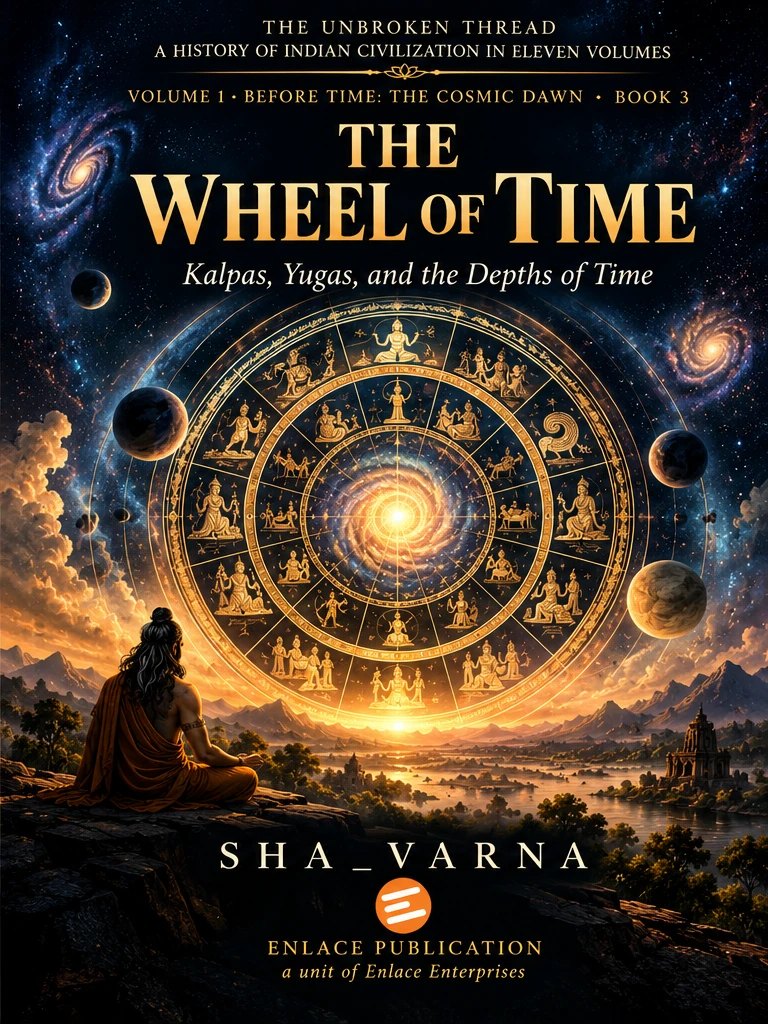
A temple priest in Ujjain locates his mother's illness inside a cosmic day of 4.32 billion years, in forty seconds, from memory. This book takes India's cyclic time of kalpas and yugas seriously, sets it beside the West's own two-hundred-year discovery of deep time, and says honestly where the two accounts meet and where they part.
References and Sources · Image Credits · The Series Map
Chapter 1 — A Clock with No Hands
The priest at Ujjain has done this every morning for thirty years, and it takes him about forty seconds.
He sits on the worn stone before the shrine, touches water to his palm, and begins the sankalpa, the statement of intent that opens every rite in India. It is not a prayer. It is an address. Before he can ask for anything, he must say exactly where and when he is standing, the way you would write a return address on a letter, and the tradition is very particular about the form.
He begins at the outside and works in. In the second half of the life of Brahma. In the kalpa of the White Boar. In the seventh reign of Manu, the one called Vaivasvata. In the twenty-eighth cycle of four ages. In the fourth of those ages, the Kali Yuga, in its first quarter. Then the year by the sixty-year cycle, the season, the lunar fortnight, the day, the hour. Then the place: on the near bank of the Shipra, in the land of Bharata, south of Meru.
Only then, having located himself to the minute inside a scheme that runs to billions of years, does he say what he has come to ask for. His mother is unwell. He would like her to recover.
Pause on the strangeness of that. A man with an ordinary human worry cannot begin to voice it until he has first recited his position in a timescale so vast that the entire span of recorded human history would not register as a rounding error within it. And he does this without any sense of vertigo, at speed, from memory, the way you might give a postcode.
No other civilization has asked this of its worshippers. The Hebrew Bible counts generations and arrives at a world a few thousand years old. The Greeks had ages of gold and iron but no arithmetic behind them. The medieval European Church, working carefully from scripture, put the creation of the world at 4004 BC, and as late as the eighteenth century a scholar could lose his reputation for suggesting otherwise. Meanwhile, in a temple courtyard in central India, a priest with no telescope and no fossil record was placing his mother's illness inside a cosmic day of four billion three hundred and twenty million years.
This book is about that number, and about the others in the sankalpa, and about what happened when the West finally caught up.
What we are actually comparing
Let us be precise from the start, because this is the sub-volume of Volume 1 where it is easiest to go wrong.
We are not going to argue that the Puranas measured the age of the Earth. They did not measure anything. There is no observation behind the kalpa, no stratum counted, no isotope weighed. What there is instead is an arithmetic, and the arithmetic has a history, and that history is genuinely interesting and almost entirely unknown outside a small circle of specialists.
Nor are we going to wave the numbers away as a lucky guess dressed up in Sanskrit. Something real was done here. A tradition worked out, by reasoning rather than by measurement, that the world is old beyond human reckoning, that it has been destroyed and remade many times, that the present order is neither the first nor the last, and that our own age is a late and diminished one. Europe reached those four conclusions in the nineteenth century and found them shattering. India had held them, as ordinary background furniture, for two thousand years before that.
The interesting question is not who was right. It is what it does to a civilization to think that way, and whether the thinking was a lucky accident or the product of something in the method.
Two ways of counting
The Indian scheme has two halves and they should never be confused, though they constantly are.
The first half is the yugas, the four ages: Krita, Treta, Dvapara, Kali. These are moral. They describe the decline of dharma, the right order of things, from completeness to a quarter of itself. They have numbers attached, and we will look at the numbers in Chapter 2, but their content is ethical, not physical. They are a theory of decay in human conduct.
The second half is the kalpas and manvantaras, the days of Brahma and the reigns of Manu. These are structural. They describe a cosmos that is created, endures, is dissolved, and is created again, without limit and without a first instance. Their content is cosmological.
Modern enthusiasts tend to pick up the yuga numbers and read them as a physical chronology, which is a category error, and then to ignore the kalpa scheme, which is where the genuinely startling thinking is. We will do it the other way around.
And beside both, at every step, we will set the other instrument: how the West learned deep time — a Scottish farmer at a cliff face in 1788, a lawyer turned geologist who made it respectable, a chemist in the 1950s who finally weighed the planet. That story is only two hundred and forty years old. It is worth remembering how recent our own certainty is before we grade anybody else's.
What this book will do
Chapter 2 takes the arithmetic apart: where 4,800 and 3,600 and 2,400 and 1,200 come from, why they are multiplied by three hundred and sixty, and why an astronomer would build such a scheme in the first place. Chapter 3 goes to the kalpa, the day of Brahma, and sets it beside the measured age of the Earth. Chapter 4 asks whether the four ages correspond to anything in the climate record, and answers honestly. Chapter 5 takes the fourteen Manus and the floods that end their reigns, and the punctuated, interrupted shape that the fossil record actually has. Chapter 6 asks when the Kali Yuga began and why the tradition is so specific about a date it could not have witnessed. Chapter 7 puts the circle against the arrow: cyclic time against the second law of thermodynamics. Chapter 8 draws it together.
And a promise, the same one this series has made in each volume. Where the two accounts converge, this book will say how far and no further. Where they diverge, it will say so plainly rather than reaching for a reconciliation. There is one number in this book that comes so close to a modern measurement that it will raise the hair on your arms, and Chapter 3 will spend most of its length explaining exactly why that closeness is a coincidence.
The priest has finished. He tips the water from his palm onto the stone, where it darkens and begins to dry. The whole recitation took less than a minute, and in it he has named a span of time in which the Himalaya are a recent event. He gets up and goes to see about his mother.
Enjoying the sample?
This is where the free preview ends. Continue reading the full book on our SuperProfile.